


Working with the microclimate, ie. climate on a scale from a few inches to one hectare, belongs to one of the more important tasks in the creation of a forest garden. We have great potential to influence climate on the scale, but how much our effort, so determined the basic conditions of the microclimate in large part by the regional and supra-regional climate. In the first part of this series on how we can create favorable microclimate, let's look closer at these influencing factors.
The above regional climate
Generally, a distinction is made between continental and maritime climate in our latitudes. Continental climate is characterized by a large variation in temperature between day and night and between seasons. The most continental areas of the world are far from the oceans as otherwise evens out temperature fluctuations due to its large thermal mass. Examples of extremely continental areas is prairie in North America and the Central Asian steppe country. Ett maritimt, ie. maritime climate with only slight variations in temperature over the year, because the sea acts as a buffer against temperature swings both ways. The most maritime climate in Europe, we find around the British Isles, which in some places is almost no difference in temperature between winter and summer.
In Sweden you measure the so-called continentality as "the sum of the temperature difference between July and January, and between day and night in June". In this way it is obtained an overview of the more or less continental areas in Sweden. As shown in the map below, we find the most continental areas in the interior of Norrland, while the most maritime areas are found in southern Sweden and along the coast.

A general rule of thumb is that herbaceous plants prefer maritime climate (where they often do not die down during winter) and many woody plants prefer continental climate. Many plants, however, adapted to a fairly wide range of climatic conditions and can thrive in both moderate maritime and moderate continental climate. Examples of exceptions are many nuts, such as hickory and pecan especially resistant to cold in Sweden, but need a warmer, more continental summer and clearer boundaries between the seasons than we usually get in order to bear fruit. Cephalotaxussläktet, called Plum yew in English, on the other hand completely dependent on a maritime climate in order to survive and produce fruit. Copies of the open Cephalotaxus (which has no name in Swedish) we find, therefore, only in coastal areas, particularly in western and southern Sweden.

Another important factor that determines the basic conditions for our microclimate is the mean annual temperature. Many plants need a certain amount of heat to get the ripe fruit and the mean annual temperature is an important factor for this. It also affects the need for heating in our homes. As shown in the map below low annual mean temperature in the most densely populated parts of Sweden between 4 and 8 degrees during the so-called normal period 1961-1990. However, we know that the climate is changing and year to date (until the end of August 2014) the average temperature has been 3 to 4 degrees above normal values, which is a very sharp increase. For the period 2071-2100 predicted, for example, an increase in mean temperature of 3-4 degrees in southern Sweden and throughout 8-9 degrees far north of Sweden, compared to the period 1971-2000.


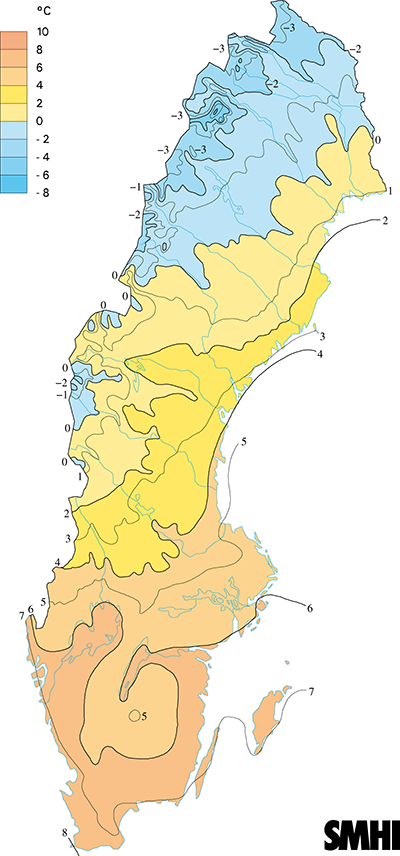
Regionklimatet
At the regional level, the climate is affected by a series of topographic factors, which all affect each other. Parallel where we are, of course, an important factor, men proximity to lakes and seas may have a greater impact. On the Swedish odlingszonskartan we see that growing conditions are more favorable the closer to the sea and the great lakes we are. Even of altitude have a large impact on the climate. Major share of the highlands of Småland, which of course is at a southern latitude, have the same production zone as Sundsvall, or in some places even Umeå. Although the proximity of the mountain has its impact. In the western slopes it rains more often, because the clouds slowed down slightly and have more time to rain off. It is therefore Boras among the wettest places in Sweden.
This provides us with some basic understanding of the climatic conditions on our sites. If you want to get more specific metrics for their place I can recommend SMHI:s data for download, where you can find information on both temperature and precipitation for many many places in Sweden: It http://www.smhi.se/klimatdata/meteorologi/temperatur/dataserier-med-normalvarden-1.7354 . In the next part of this series, we will dive deeper in detail and look specifically at the factors affecting the microclimate.
Interesting! Thanks for the info.
Inger