


Both the supra-regional and regional climate we need to relate to when we design our forest gardens. Still, microclimate differ much from the general conditions. Through active observation, we can learn much about the local microclimate. The knowledge we thus get up can help us create site-specific solutions, whether it involves placing a vegetable, a house or the right tree in the right place. But we can also use the knowledge to manipulate mikroklimatet.
Do we do this in a sensible way, we can improve growing conditions and may increase the distribution area of some plants beyond the latitude where they usually occur. This may in turn increase the diversity of both plants and animals on our sites. We can also reduce energy consumption in our house if we plant lähäckar and captures the sun's heat in the right way. In windy areas, a well planned lähäck save 10-25% of heating energy. Not least increases an improved microclimate yields from our farms. How do we do to improve the microclimate?
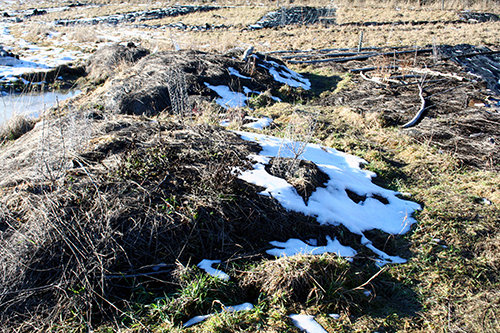
We can accomplish this by attacking the various factors that affect the microclimate. Temperatures is particularly important in our harsh climate. The higher the temperature, we have the growing site, the better the harvest, both with respect to quantity and quality, we can expect. One way to work on the improvement of temperature conditions is to create inclines in the landscape, for example by constructing raised garden beds, small farming hills or swales. The inclined plane facing the sun receives more sunlight and a rule of thumb is that each degree of slope extends the growing season by a day in both directions. The face of farming hill that faces away from the sun will be both colder and wetter, which may be of advantage if you want to create more habitats in their cultivation.
It is important to work with both day- and the night temperature. During the day it is important to concentrate sunlight, so that the plants have special heating needs may be extra warmth. This can be accomplished by, for example reflective surfaces white walls or water mirrors. Such surfaces have a high albedo, which is the designation for a surface reflective ability. A water mirror reflects 50 to 80% of the incoming sunlight and well-placed plants can thus get a significant improvement of their habitat.

Night time is the opposite is true. Instead, to reflect and concentrate sunlight, we want to store the sun's heat to have a buffer against the lower night temperatures. Many plants, such as tomatoes, grows poorly if they have to put up with temperatures below 10 ° C at night and you can get considerably better yields if they manage to keep the temperature above 10 ° C. This can be achieved by selecting the surfaces with low albedo, Thus, surfaces with small reflective capability. Firs belongs plants with low albedo and absorb up to 80% of the incoming sunlight, they give off slowly when the temperature drops during the night. Dark stone walls are an excellent heat storage, but you have to remember that the effect of both trees, stones and walls extending not more than a couple of inches.

Therefore, it is also working with Air mixing, which we will look at in the next post on microclimate in forest garden.