


Chestnuts hear too many to Christmas, but most know enough not think it is perfectly possible to cultivate chestnut in Sweden. If you live in the warmer parts of the country that is. What we buy in the shops are usually sweet chestnut (Castanea sativa). Sweet chestnut grows relatively well in southern Sweden up to cultivation zone 2 and no copies are also available in cultivation zone 3 (and, indeed, a copy of Putt Myra forest garden, but it does not feel particularly good).

In the same genus, there are other species that might be interesting for cooler growing areas. Chinese chestnut (C. softest) is possibly hardy to zone 4 and this year we planted a few trees in the Putt Myra forest garden. Many experts I have spoken to say that it is not possible to cultivate in Sweden, but I still think it's worth a try.

Japanese chestnut (C. crenata) considered to be somewhat less hardy than sweet chestnut, but hybrids between C. crenata and C. sativa has been described as resistant in American literature [1] and operate safely in the production zone 1 and 2. The American chestnut tree (C. toothed), that once covered large areas of North America, has almost eradicated there by a fungal disease, but there are a few trees in Sweden who seem to enjoy our climate.
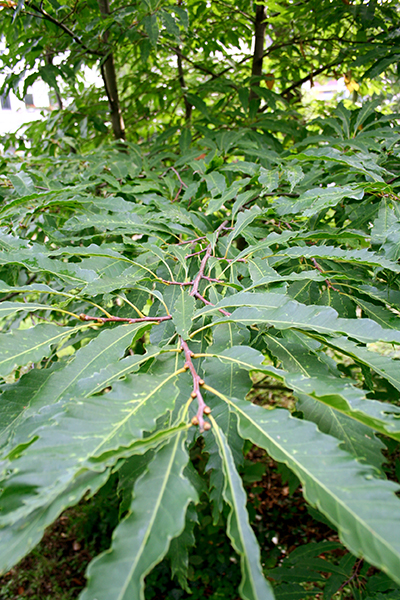
Chestnuts are very starchy and is therefore sometimes called corn on the tree [2]. The chestnut is possibly the trees with the greatest potential to provide us with a carbohydrate-rich staple food, but resistance is still a challenge in large parts of Sweden. Name resorts usually provide harvest already when they are five years old and chestnut hybrids gives higher yields than pure species. Trees that are ten years old or older can provide 5 tonnes per hectare, which means that each tree yields around 25 kg chestnuts [3].

In the next post we'll meet some real extreme growers who I happened to get to know on a trip to Jämtland…
Literature
[1] Falk, B., The resilient farm and homestead : an innovative permaculture and whole systems design approach. White River Junction, Vt.: Chelsea Green Pub., 2013.
[2] Shepard, M., Restoration agriculture : real-world permaculture for farmers. Austin, Texas: Acres U.S.A., 2013.
[3] Crawford, M., Nut Crops – Appendices, 2012.
Chestnuts for Swedish climate is very interesting. I have a couple of pieces that germinated from the nuts 2009. I do not know what type it is, men inte Castanea sativa. The mother tree was standing in a courtyard in the center of Stockholm, and left there thus ripe nuts. Here with me in the zone 3 there has never been any winter damage, not even the harsh winters 2010 and 2011. Extremely hardy trees that seem to do anything and thrive on poor, on sandjord. Only remains to see how the nuts are here.
What fun! Where in Stockholm was the mother tree? Would be fun to pick some nuts for the propagation where.
I sat in a cafe on a semi-open courtyard in Stockholm during a neat tall tree with consistently tribe in Stockholm. I saw that the fallen chestnuts himself had sat in the grass under and was very surprised. They were smaller than those purchased in the store but tasted the same. Absolutely believe that it was C. sativa. Now it is rebuilt there and the tree is sadly escapade. I managed to pick a few seasons, and distribute to others, so it is growing such trees on islands in Lake Mälaren and Stockholm archipelago and the other places I do not know the. They have grown better than the purchase chestnuts that I sowed. Especially the Chinese from the store, (who really have mixed genetic background), has frozen down often and much. A nursery chestnut has been ripe fruit once, Another growing up as an oak tree in the forest edge, no frost damage in ten years.
I actually got my chestnuts precisely Anders who answered above. That said do not seem mother tree stand there anymore, otherwise I would have gone there and gathered more chestnuts. Anyway it is not sativa, among other things, the short petiole and not long as sativa. Then there are other clues to look at, as if the leaves are dull or shiny, thin or thick, the edge looks. The color of the twigs is also a clue, as well as any thin hairs on the nerves underneath the leaves. When spring comes with new leaves, I will try to sort it out with chestnut growers in the United States who have more experience.
Other, it was just a tree in the courtyard or where there were several? Most chestnut varieties should not be self-fertile so it may be a clue to what tree it really is.
Aha, Glad you got until it's not C. sativa. The tree was planted in the 70s, moreover,. I'll check the blades firmly on the trees that sprouted and compare with sativa. They grew by one-meter shot this summer, hope the animals eat other things in winter.
Now I remember unfortunately there were more trees. It was more stems but I think it was because they had not chosen a main stem as small plant. And not even sure if there was a stand-alone to. As, you can not get someone clue about pollination conditions, unfortunately,…
I still have not managed to figure out exactly what the chestnut is. Gothenburg Botanical is a tree that is very similar with the only written “castanea sp.” on the sign so they do not know either. Their trees as well as the middle has a strict tree form, no tendencies to buskighet that otherwise looks of chestnut in Sweden. But either way, my biggest trees bloom this year. Germinated from beef 2009 so it has only taken nine years. Someone pollinator is not so now we will see if it is self-fertile. If so, I will take care of every single note in the years to come and fill the woods with chestnut seedlings. I see tremendous potential in this tree.
If you find out what a chestnut is, feel free to write here. They are clearly healthy and growing well, of course interesting to propagate further.
Still no idea. Har “thorn balls” at the top of my tree now, but they are probably empty. The leaves froze again this spring, but the tree recovered quickly and has annual shoots of 50-60cm every year so it grows so it cracks. Looks super fresh and nice. Torkan 2018 it did not care at all, did not even notice it. But I found another plant in the forest last year, which has stood under a willow bush all year and has only become half a meter. I have moved it forward now and hope it will speed up and grow so I get some pollination in the future. Then I have another one up in a mountain that grows slowly, it is too big to move but too small to bloom.
And, but then there is perhaps a slight interference of another Castanea, if you found deviations from C. sativa. Now Philipp has seen the trees, and on my question if it could be C. dentata became the negative answer, they should have smaller leaves. And then I got the information that it is very common with arthybrids, because they are easily cross-pollinated. Can also mention that I got a few, small nuts last year, despite many flowering trees. It was the first year of fruiting, so maybe that's why few evolved. This year has two trees that are probably C. molissima bloomed at the same time, so better pollination has hopefully taken place.
And, it is not pure C. toothed, I have some small seedlings of them and they look different. Sure C. sativa with a small part of of something else in. Who knows, it may have been the same researcher in the Soviet Union who produced hardy walnuts that were also working on chestnuts?
Glad you got nuts. So were they round and filled? The tree at Gothenburg Botanical had thousands of nuts lying under it last year, but all were empty. The nuts themselves were there, but they were just empty “bags” without content. I have never found my own, I only get a few every year for so long.
Already, last year most empty, but some fed C. sativa and these, (hybrids?), but still small.
There were a few small chestnuts on C. softest, many on my other trees. Has given away and changed, sown in the ground, will see if the frost reached them this winter, then they will probably not germinate.
Are all edible chestnuts? In Örebro (sun 3) flourish;!
If you mean sweet chestnut (all species within the genus Castanea), they are edible. Hästkastanjer (Aesculus hippocastanum) available as park trees in many cities should not eat and they are not related to the true chestnuts.
Aha. Ok, thanks!
Hi
Where to Buy chestnut is not edible finds no trees ?
Hi!
Do you mean where to buy chestnuts? Or sweet chestnut?
How have your chestnuts been planted?, have some started giving you chestnuts yet? I'm thinking of planting a Chinese. + A European in the zone 2(3) to get chestnuts to harvest on at least one of them. Do you think cross-pollination is reliable between them to get a harvest? Which of them should be planted in the most favorable location?
Winter 2017/2018 many trees were damaged by vultures, but most have scratched themselves pretty well after that. However, it will take a while before we get any fruiting, so far we have not even seen the hint of flower teams. Cross-pollination between two trees usually works as long as he- the female flowers bloom at the same time. However, there are some individuals who have sterile male flowers, so it is important to keep track of the properties of the varieties. With seedlings, you never know before what it will be like, but it is possible to graft more varieties on the same tree as you go. I would say that C. mollissima is a little more sun- and heat demanding than C. sativa.
Thanks for the reply, thought the Chinese were hardiest. The grafting sounds interesting as an alternative to two trees, do you know someone who can graft hardy varieties to order?
Seems like there is an Austrian Sativa that is self-fertile and bears fruit early, Ecker 1. If my German is correct, it should be possible for me in the zone 2(3). Do you know anyone who has tried it in northern conditions?
And, ‘Ecker 1’ is said to be both self-fertile and a little extra hardy. Unfortunately, it is also susceptible to chestnut cancers and it seems difficult to get hold of trees that come from safe areas. (where chestnut cancer does not occur).
And, it is a risk, but you should be able to trust larger players such as Eggert, for example? Cancer is a problem for all imported Sativa?
Chestnut nursery, an organic nursery in Austria, offers 3 Ecker 1 on barrot for 69 Euro including shipping to Sweden. Can be combined with the Ecker hybrids 2 and BdB which are more resistant. I have ordered 2 Ecker 1 and 1 BdB then Ecker 2 appears to be more vigorous. Delivered after 15 april.
Actually, a health certificate is required to be able to import chestnuts to Sweden (also as a private person), because Sweden is counted as a protected zone for chestnut crayfish. Few in the nursery world know this and we have not been able to find any suppliers in Europe that can issue such certificates. More information can be found here: https://jordbruksverket.se/vaxter/odling/vaxtskydd/karantanskadegorare and here: https://jordbruksverket.se/vaxter/handel-och-resor/vaxtpass-sparbarhet-och-andra-atgarder-mot-vaxtskadegorare-inom-sverige-och-eu.
Tack, as I interpret it, the import ban applies to plant operators who carry out some kind of activity. Of course I will destroy the plants and also report if there are any signs of disease. I have 500 m to the nearest neighbor and hardly think there are other chestnuts within a radius of 4 km so it should be safe enough.
Du har nog rätt att ansvaret ligger hos den som säljer plantan att informera sig om vad som gäller i Sverige. Dessvärre kan kastanjekräfta också spridas till bland annat ekar (som inte lider av den), varifrån de kan sprida sig vidare till andra kastanjer om det finns.
I checked out some nurseries to find sweet chestnut, but it seems difficult. I must leave for Georgia to collect seeds or seedlings, there is somewhere that you know?
Hi!
You can find sweet chestnut example of these nurseries:
http://www.westergaards.dk/kastanje
https://www.agroforestry.co.uk/product-category/plants/nuts/chestnuts/
Please
Philipp
Tack!
Hi! I have now is C.sativa 4 m high and that gives fruits but only a very few become big. Is it because of our climate? Lives in Kristianstad (sun 1) and the mother tree found in Alnarp.
Hi!
It may be due to poor pollination also if you have only one plant. Chestnuts are self-fertile, but give more fruit if you have at least two different individuals.
/Philipp
Hi
Today has been and blockat chestnut on the lawn, but for a very famous Cafe 'outside Sjöbo in Skåne.
The chestnuts are about 25mm in diameter, not so big, but healthy good.
Had intended to plant some of them and see if you can obtain one or a few plants.
Is there anyone who can provide information on how to make the best terms?
Should they be soaked in water for a few days, know some nuts need it?
You can plant them directly in the same year or is it best to wait a year or spring is the best?
What kind of soil is needed?
Thought try to cultivate in pots indoors first and then planted out in the spring.
Evil
PS: Growing Genuine Chestnut on municipal land in central Malmo Go ahead.
Hi!
It is best that as chestnuts at once. Add them with the flat side down on flat ground and fill with more land, best with soil that you dug up from an existing tree. Then the pot need be mussäkert, frost-free, but cool all winter (close to zero degrees). Earth cellar is perfect. The chestnut tree germinating often already in late autumn or winter. The rot if it freezes.
Good luck!
Hi! Did you write that you picked sweet chestnut outside Sjöbo. Which way then? I myself live in Vollsjö. Is it just and pick? Would love to try and obtain a plant.
With kind regards,
Carina
I sowed a purchased chestnut (Thus chestnut) late fall 2005. When the cave, become plant, I put in about 1 years out in the open in Sörmland. It grows significantly, now after 10 year about 4 meters high. I have cut / stuttered up so that the tree has the form. (By itself seemed the most like to be a bush). Covering the soil surface with dry leaves and spruce boughs in winter. Since 2 years I have seen the light yellow long catkins, but no fruits formed. Eat very happy tree – it is beautiful – but would of course be even happier if it bears fruit. Anybody have any idea?
Kristina
I sowed a few chestnut fruit I found in the Botanical Gothenburg. There were lots of chestnuts under the tree but they were rotten but I managed to find a few that passed the winter (which was a bit sheltered in / in the grass). I picked them in late April and put them superficially in the ground so that I saw some of them. Now it has come up small stalks with leaves, Just a few weeks later.
Hi, where in the botanical in Gothenburg is the tree??
There is a good map of many of the trees at Botan, is: https://botaniska.gardenexplorer.org/taxon-19214.aspx.
Tack!!
Hi!
We live in Malmo, and for about 4 years ago, we planted a chestnut (matkastanj) in our garden. We bought the plant in Flyinge. It is about 2 m high and every year the mass of delicate leaves and some sort of long beige flowers. But we never get a few chestnuts. How long does it take for us to pick some chestnuts? Are there any ever?
Grateful for answers.
Petra
Hello Petra,
chestnuts needs like apples cross-pollinated, so it may be that's the thing. You need one to plant that is a clone of the plant, you already have. Glad it blooms so early anyway! As soon as you get to pollinators may be nuts on the tree. Good luck!
/Philipp
Hi!
My sweet chestnut (castsnea) seeded 2005 in Sörmlandsleden (see previous posts) and is now about 8 meters high this year, first year with fruits. How many – hard to see – nuts sitting high. Maybe it 40-50 st. To my knowledge there are no other trees in the neighborhood, so this seems to have fertilized himself.
Is there anyone who knows when o how to harvest?
Kristina Sörmland
What a pleasure to hear that there's fruit on your tree! A few individuals may be completely or at least partly self-fertile, but it is rare. However, what may happen is that the shells that you see high up in the trees all are empty. I've seen in several places around the country where chestnut stands alone, It is believed there is a bunch of nuts, but in the end there will be no harvest anyway. The chestnuts tend to fall off when ripe, and then splits the prickly casings up by itself. It usually occurs during the first half of October about, but this year everything seems to be a little earlier than normal. Keeping my fingers crossed that you really have a självfertilt trees! /Philipp
Great expectations when I examined them thorny (Oh so thorny) envelopes and discovered that they 3 nuts that were in any case was not nuts but just empty shells. Disappointment. But little prepared, I was of course thanks to Philippe's responses. Thanks for that. Now I rejoice in it about 9 meter, beautiful tree planted 2005.
Hi!
Thank you for writing so well about the great chestnut trees.
Personally I live in the Netherlands and in the woods outside of where we live, there are hundreds of chestnut trees that supply bärkassevis with chestnuts in October each year. Much more than people bothered picking.
I have planted chestnuts every year, and the hardest thing is to keep away the mice in the winter.
Some small plants, I sat with the parents in Trollhattan, hope to survive…
Are there any commercial chestnut growers in Sweden than?
Goran
Hi!
I picked lots of chestnuts this fall, for decoration but also to try to germinate.
The ones I did not have for decoration I put in the freezer, brought them out a week ago, put them first in water in 2 days ago I put them in a box with damp paper in it.
Have checked every other day how the nuts feel and what they smell!
Suspect that they are fermenting?.
Ska ja hålla ut eller är dom förstörda?
Någon som har en aning?
Bor i Värmland 🙂
Hi! Is it horse chestnut or edible chestnut you have picked? If it is edible chestnut, it can not withstand more than a couple of degrees below zero, so freezing understands the seed. I do not have a good idea of horse chestnuts, but I would think the same applies to them.
Please
Philipp
today's book reviews: “Trees of Power” of Akiva Silver. An entire chapter about growing up chestnuts from seeds.
Search happy on Youtube after “Twisted Tree Farm” or “Edible Acres” Video instructions.
Just thought I'd tell you that it grows two copies of the chestnut in the Bergius Botanic Garden in Stockholm.
I was there and picked fallen chestnuts yesterday
One is on the right side of the entrance of Edward Andersson's greenhouses. Ie on grass platelet on greenhouse north-west corner.
https://www.google.se/maps/place/59%C2%B022'09.7%22N+18%C2%B002'45.2%22E/@59.3693611,18.045045,278m/data=!3m2!1e3!4b1!4m6!3m5!1s0x0:0x0!7e2!8m2!3d59.3693626!4d18.045881
The other, greater tree is the slope down towards the headland at the water northwest of the Italian terrace. This tree, however, had much smaller chestnuts.
https://www.google.se/maps/place/59%C2%B022'12.8%22N+18%C2%B002'27.2%22E/@59.3702222,18.0400449,278m/data=!3m2!1e3!4b1!4m6!3m5!1s0x0:0x0!7e2!8m2!3d59.370209!4d18.0408998
Thanks for the tip!
Now it has started to ripen chestnuts on one or two of the trees I sowed for approx 12 years ago. They are on the north slope, perhaps it is the case that they need a warmer location as high up as Uppland to be able to mature every year. It will be frost tonight, will see if there are more mature ones. The trees are very viable, so they can be suitable for pollination of name varieties or be inoculum for name varieties. They were sown on site, and the vast majority came up so they stand too close today.
Hi. If you live in Brunskog in Värmland – and slow sun 4, in the middle of the biological northern border – is it run with chestnut cultivation then? If not which variety we should invest in, and where to get them?
Please:
John and the Wild Heart
Hi! We have planted a lot of chestnuts here in zone IV / V and they grow nicely. They have not suffered any frostbite to any great extent. Whether they will bloom and bear fruit is of course very uncertain, but with increasing warming and season extension, it will certainly be possible to harvest eventually. We grow an intersection of C. mollissima with other species. They are difficult to obtain, however, and are usually pulled up from seed. /Philipp
Hi. Now I look at my ex. of “Forest Garden” that you are the same Philip who is polar with Viktor Säfve, an old friend and forest activist colleague of mine and Mia.
Anyway, back to the chestnut weights: It is not the case that you can buy small ellingar or possibly. nuts of you? Or maybe by someone else you know?
I'm emailed you!
Rickard Perkins har planterat ett flertal Kastanjeträn på sin gård (ridgedale) utanför Sunne för ca 8 years ago.
Vet ej hur det har gått än.. men rekomenderar att kolla med han
https://youtu.be/FV65sVqoTTo
Tidigare har flera beställt utsäde från Grimo Seeds i Kanada. De har en genpool som kan vara mycket intressant, med tanke på härdighet. Now I have received a message from the authority that issues the certificates, that they cannot guarantee freshness, the chestnut canker is widespread. Still, the nuts are infinitely safer to import than whole plants / plant parts. And the stop also applies to private individuals. Now it should be a good opportunity in Sweden for those who have good material for inoculation and inoculation, to propagate promising varieties for our climate, there is demand. Imports are no longer possible.
Certificates are required from Canada, but within the EU, plant certificates for private individuals, as I interpret them, are enough. Maybe best to not do it anyway, even if the infection is already said to exist here in Sweden if it uses Ekar as vectors.
Hello group!
My girlfriend and I are sooo tagged on trying to grow real chestnuts. If there is any soul in the group that has seeds / nuts left over, I am happy to buy a few. We live in Malmo.
Regards,
Aldin
Hi!
I have put a chestnut that I bought in the grocery store, straight into the soil where it germinated and has now grown seven meters tall and for the first time has got lots of spiky balls at the top. From what I understand from the above post, it probably has empty shells, so it will be good to plant some more trees. As a tree, it is very decorative with glossy, hard leaves and a fine trunk that grows in a slightly zig-zag pattern. I wonder how to tell if my tree has cancer? Then I wonder if anyone has tips on how to get nuts on cork hazelnuts. It produces lots of spiky nut clusters that are all empty of nuts. I have a couple of common hazels but they don't seem to be able to pollinate the cork hazel.
HEJ
I live outside Linköping and have 2 st chestnuts that I have grown from some fruits that sprouted from the ones we bought in the store.
It is now approx: 20 years ago and we have had fruit in the last few years, but this year it seems to be just a little bit, but lots of it ! Last year there were fewer but larger fruits.
My experience is that late frost kills the leaves but so far it has always managed and put new shoots.
//Day
It seems hard to get seeds for anything other than European chestnut here.
Tips on American or Chinese chestnut trees or their hybrids growing in botanical gardens are gratefully received, parks and plantations in Sweden.
I'm not a chestnut expert, but here at Tjörn there is a variety that doesn't look like them “usual” in Gothenburg, with large balls and few thorns. This has less and is full of “hairy thorns”, I think it says Real chestnut on the sign. The tree is approx. 3 m and found it this summer at Sundsby estate.