


I post any toxins in newspapers I viewed primarily on the mineral oil-based solvent in the ink. But what of the pigments when? Many approached him and asked if there can be unpleasant substances such as lead and cadmium in printing ink. I have done some research and fortunately we need not worry too much about any heavy metals. But really calm, I feel still not having gone through countless safety sheets of the pigments contained in the ink.
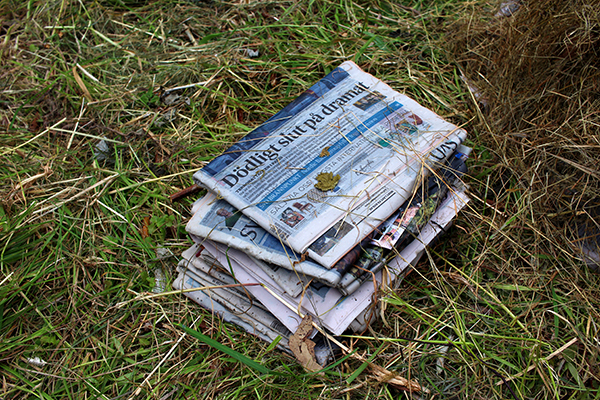
All modern newspapers are printed with a technique called four-color printing. To get the different colors we are used to see in our newspapers mixed the four colors which in English is called Cyan, MAgent, ANDellow and Key (black), which form the acronym CMYK occasional might have heard of.
Cyan get their color from the substance copper phthalocyanine. I higher doses are subject quite toxic to humans, but it takes hundreds of thousands of times the amount found in newspapers that they pose a danger. Unfortunately, the environmental impact of the manufacture be right high, but there is nothing that has any direct bearing on the use of newsprint mulch in the forest horticulture, when it is not pressed more newspapers only because we use them as cover material.
Magenta usually consists of a pigment called Violet 23 which also has the name 9,19-Dichloro-5,15-diethyl-5,15-dihydro-diindolo[2,3-c:2′,3′-n]triphenodioxazine and which consists of carbon (C), nitrogen (N), oxygen (O) and chlorine (Cl). According to the safety sheet on the subject that I have been able to find it harmless to humans even in much higher doses than those we find in the newspapers. Unfortunately, however, it is also that the substance is broken down very slowly in nature, which is probably seen as a positive attribute in pressure situations where you want to have resistant dyes. Its ability to accumulate in nature and what it might have consequences are not even investigated.
To the sugar the color most often used a pigment called Yellow 151. It will not break down nor especially fast, men according to safety data sheets should the pigment to be harmless. Again, the ability bioaccumulative never investigated.
The black paint consists of pure carbon (C), which is not good to inhale if it is handled in powder form, but otherwise it is completely harmless. Unfortunately added a blue pigment (Blue 61) to the black color to spice it. Again, it is a poorly investigated topic. I a safety sheets I was able to find it is well that the substance is not subject to the EU:s klassificeringsregler, and that it should not enter water or soil. There seems to be something harmful to aquatic organisms, but it is not clear what doses it concerns.

So what conclusions can be drawn from all this? For me, it becomes obvious that there is something very weird in our society, when we use large quantities of chemicals whose effects on ecosystems we have hardly any idea, not least as regards the interaction between different chemicals. It is a political issue that needs to be resolved elsewhere than in the forest garden, t.ex. by supporting SNCC in their work for a poison-free society. Do we want to reduce our exposure to toxins, the newspapers probably the wrong place to start, as it relates to remember that we consume significantly more chemicals just by staying in town, Sitting in a car or use a motor mower than if we put out a few hundred newspapers in our woodland gardens. I will therefore continue to use newspapers in the forest garden during the establishment phase (they are just unbeatable efficiency), but will work even harder to phase out all apparently poorly studied chemicals from other sources out of my life.
Ah, interesting reading! It's good to be able to use the newspapers one more time after reading them, but it's a shame that there needs to be harmful substances in the print at all.
Thanks for letting me know about the results!
Inger
Interesting to read about your thorough review. The acute health risk is perhaps when you take in the newspapers, browses, licking fingers, scrolling again..(not to mention the mental pollution from the content of most newspapers when reading them).
But I agree with your conclusion. The chain doesn't end either, even if you don't use them as cover material. Are they left for recycling to be washed or re-ground into new paper pulp. Where then do the substances go from that process water? Perhaps soil microorganisms are better suited for degradation in aquatic environments? etc..
But first and foremost, it has to be a systems approach.
According to Patrick Whitefield, newspapers also have an accumulative effect on aluminum as it is required in the production of recycled paper. I have ivf chosen cardboard instead but haven't had time to check if it is that much better.. Someone who knows?
Good information on use of papers, However I’ve a question? When we bought this place I found thousands of old papers all black ink, no colors, from the 1920’s thru 1970’s in the barn. I’m thinking they should be fine for use, but wondered if in your research anything to indicate that old papers like these might be toxic?
Thanks,
Ron