


Vole has been the worst pest in Putt Myra woodland garden and judging by the many questions I have received from other forest horticulturists seems to be similar across the country. In Sweden there are two types of voles, water vole (Arvicola amphibius) and vole (Microtus agrestis). They are found throughout the country except in Gotland, that are completely spared from both. The water vole is worst no one among the two, as it likes to eat the roots of trees and shrubs. Often, the entire root system after the water dried thank overturned tree is a sad sure sign that there is water voles in the garden. Best of all votes water vole on apple trees roots, but other Rosaceae such as cherry, pear, plums and Amelanchier alnifolia attack also. Tree of moderate vigor rootstocks (as B9) is an easier prey for water voles than those with strong growing rootstocks (as A2). We have also received injuries on chestnuts (Castanea x mollissima), havtorn (Hippophae rhamnoides) and bärtry (Lonicera caerulea var. edulis). Field vole attack usually only the above-ground parts of the trees and call barks happy apple.

To understand how to combat vole, it is important to understand which habitats they prefer. The water vole is very adaptable and thrive in farmland, meadow land, gardens, fruit- and berry plantations, grassy roadsides and similar habitats, preferably with a proper lush vegetation. Proximity to the ponds, wetlands, open ditches and various streams facilitates both the spread and födosökning water vole. It sounds like a description of Putt Myra forest garden, which explains why we have had so much trouble with vole. In the light, humus-rich soils cope vole better than in heavy clay soils.
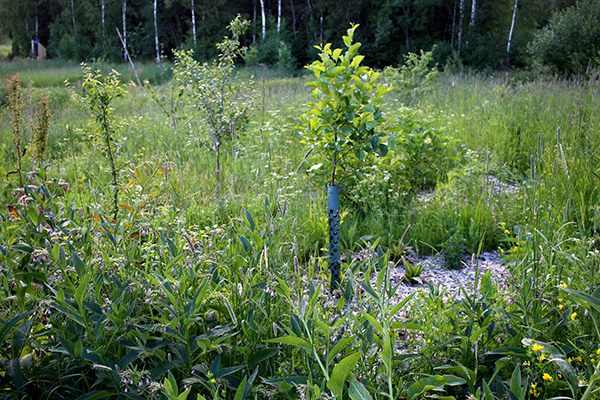
The number of voles change in cycles and population peaks achieved every fifth to tenth year. We have matched such a peak year 2013 when we planted most of our apple trees and got rid of a dozen trees in a single season.
Mulching and voles are usually a bad combination, especially black plastic sheeting (we used in amounts) creates perfect conditions for water vole: it gets dark and hot and birds of prey can not access voles under the plastic. Even straw and hay is said to attract vole. The only cover material anyway vole are not attracted to wood chips, which also has a lot of other positive qualities, so we will concentrate even more on chips as mulch in the future.

What can you do against voles? The somewhat disappointing answer I found a SLU report which is the basis for this [1] is that almost nothing works really well, especially in the long run. I have often heard that the planting of some plants around their trees to deter voles, such as daffodils, garlic or valerian. Others have said that I would pour down surströmming, Blood, sour milk or other disgusting in vole aisles. At best, it works a week or two, but voles get used to it quickly. For the same reason, do not work the sound producing contraption engines that can tap into the earth. The animals get used to the noise and will happily return after a short while, which of course also have their fast reproductive cycle to do. If the new generation growing up with constant noise and smells fermented herring are accustomed to it from birth and do not know of any other. While gassing with carbon monoxide or carbon dioxide is a recurring suggestions I get when I talk about voles, but in addition it is a laborious control method is also its effect is very short-lived.
How should we relate to when vole? More on that in the next post about voles worries.
References
[1] Jansson, R., J. Albertsson, S.A. Svensson, and t.o.p.S.L.U.A. Enclosure administration – cultivation. Control of water vole and field vole in Swedish orchard basis for training module. 2010. http://urn.kb.se/resolve?urn=urn:nbn:se:slu:epsilon-5-153,
Voles can be a big concern. I understand that castor oil will be a good “pesticides” against voles both above and below ground. Does anyone have experience with this?
Voles can be a big concern. I understand that castor oil will be a good “pesticides” against voles both above and below ground. Does anyone have experience with this?
Finnish lap dogs are good at hunting voles. Keeps even after the deer if you have a line of hunting.
Hej Philipp
You've completely missed the natural predation of Ural owl on water vole! Ural owl should be in the neighborhood Stjärnsund (they were in Västmanland when we were there in the spring ugglesafari) and they nest preferably in boxes so you can control their nearest födosökområde to Putt Myra. Slaguggla ska iaf enligt vår uggleguide tycka mycket om vattensork så det borde vara ett vettigt sätt att hålla ner deras antal.
Tack för upplysningen om spansk körvel.
– I Kloster väl ett arv från munkarna.
Och det kanske inte är en tillfällighet.
Plantera spansk körvel under fruktträden kanske.
Värt testa. Tack igen.
vi har en parson russel terrier som är hård på sorken 🙂
Vi med☺
Sorken gillar inte att bli störd.
Nu är det 2018 och snötäcket har varit ett gott värmande täcke för vattensorken i min trädgård, Sågarbacken i Kloster. Aldrig har jag haft så stora skador och jag vet faktiskt inte vad jag skall göra. Förstår nu varför förra ägaren (for more than 30 years ago) had all the flowers in pots and no perennials.
My Jerusalem artichokes, which I was so careful about so that it would not spread unchecked, they are now eaten. But there is plenty of Spanish chervil!
Thanks for the really nice consolation Article! Lollo
Tack för upplysningen om spansk körvel.
– I Kloster väl ett arv från munkarna.
Och det kanske inte är en tillfällighet.
Plantera spansk körvel under fruktträden kanske.
Värt testa. Tack igen.