


A while ago I wrote about Dynamic accumulators are plants used in forestry gardens to create and maintain a good fertility. One of the most powerful dynamic accumulators are comfrey (Symphytum spp.). Comfrey has very deep roots and accumulates all sorts of minerals in their leaves. Above all, potassium and calcium, but also the phosphorus, magnesium, eating, iron, selenium and zinc retained in the leaves. When the plant dies down in the fall release of nutrients present in the leaves and it becomes pure smorgasbord of worms.

Another advantage of comfrey is that it manages to be fertilized with large amounts of urine without suffering damage. I have seen that it has been used as a border plant around heaps to take care of nutrient. Grassland herb begins to grow immediately after snowmelt and well into autumn, and can therefore capture nutrients during much of the year. The nutrients can then be made available to other plants by cutting the leaves and use them as mulch around the bushes and fruit trees, for example, who need just the nutrients found most of the comfrey to give good harvest. By using comfrey as cover material and not urine or manure directly, we can also reduce the risk of transmission of pathogens, for example, strawberries or leafy vegetables.

Another way to make nutrients available is to manufacture its own slurry of vallörtsblad, happily mixed with nässelblad (Additional nitrogen) and horsetail (which contains much zinc). I usually fill a bucket with large green leaves (but to pack up the leaves) and then keeps up with water up to the edge. After a few days it starts to smell terrible, so it's good to have the bucket standing on a well-aerated place. Then I used some manure with ten parts water and watering my plants in pots with the. It is visible almost instantly how good tomatoes and peppers, but also perennial vegetables, feeling of nutrition.
In addition to helping with fertility, I also use comfrey as a border plant. Its root system is like a wall of thick, woody roots that becomes almost impermeable to weeds. I agree to plant comfrey along with all the great trails in the Putt Myra forest garden and around all beds. When grassland herb has grown into itself creates it also a nice habitat for beneficial insects; especially spiders, I have seen thrive great in the big leaves shade.

A great disadvantage of the usual in Sweden soils around forage herb (Symphytum × uplandicum) is that it is very invasive. It is a hybrid of Symphytum asperum (S. aperum) and genuine comfrey (S. officinale) and is really only partially fertile, but it does not prevent it from spreading quickly using seeds. With me is the Uppland grassland herb in a similar class as ground elder in terms of the ability to spread and I regret that I took it in my home garden. The thing to do is to prevent them from being in bloom, but it is easy to miss a seedling hiding in some inaccessible corner of the garden.
Fortunately, there is a name kind of Uppland grassland herb called 'Bocking 14' and are completely sterile. It adheres to a place and can only be propagated by division. The variety was discovered by an English gardener in St. Petersburg Botanical Garden, which brought it home to England in the mid-1800s. It is named after the place Bocking in England where vallörtspionjären Lawrence Hills had a large sample cultivation of all sterile varieties of comfrey as he could find in the UK. Anyone who he thought was the best of all (he examined them primarily based on their value as animal feed) was the variety that grew in a row 14, hence the name. Bocking 14 has enormous growth potential and can be harvested for mulch four or five times per season in Sweden if it gets enough water. There is also another Bocking-kind trade, namely 'Bocking 4'. It is sometimes called kökscomfrey, but I would not recommend that you eat it. Moreover, it is not the same vigor as its cousin No. 14.
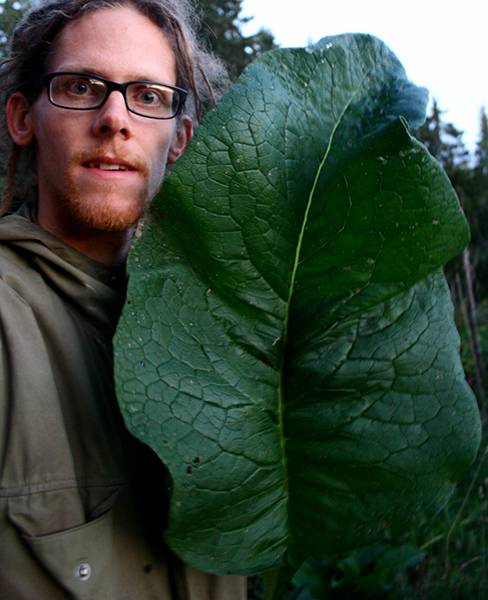
If you want to establish 'Bocking 14' in his garden, it only works with ready seedlings or root cuttings. Root cuttings taken after the frost is gone out of the ground, or any time later just before the growing season begins. You lift up the root system with a pitchfork and breaking of large rotbitar. It is best to take from plants that are less than two years old, and one can get between 15 and 30 new seedlings from a parent plant. Then you cut rotbitarna into small pieces, about 3 cm long. They can stop into the earth directly. If you want more control over the plants, it is better to put them in small pots. Then we just have to be patient, it can easily get to the middle of May or early June before the first leaves turn out. It seems that comfrey want to be completely on the safe side weather-wise before it sends out new leaves from the minimal rotsticklingarna.
Vill man få tag på den här dunderväxten säljer vi rotsticklingar i vår online shop. De kan beställas från januari till slutet av februari, eller så länge lagret räcker. They come in packs of 10 pieces for 130 SEK and there is free shipping in Sweden. Delivery will take place in early April, provided that there is zero temperatures.
Other selling 'Bocking 14':
Martin Crawford (http://www.agroforestry.co.uk/): Sell both seedlings and root cuttings.
Helenion (http://helenion.de/): Sell only plants.
En bra genomgång av hur vallört odlas och vad det kan användas till hittar du här (in English): https://happydiyhome.com/comfrey/.
Litteraturtips
[1] Hills, L. D., Comfrey : past, present and future. London, 1976.
In Stockholm, there are free * comfrey in two places to download. At Stockholm University's Forest Garden and Kräppladalens Forest Garden, Rågsved.
Many bushes, (Gooseberries & Currants) in Kräppla now purely natural begun to poke its branches bowed down to the ground, which we gladly share with you. It is also possible to take some cuttings of other things too.
(*We assume no charge for this but would like to see that you're helping and working a bit in the forest garden one hour or so, safe fun and educational for you with).
Then we have a small private nursery with a lot of potted timber garden plants at my house and Margaretha , 200m from Forest Garden in Rågsved. Call regardless 0739229923 or 0738045039.
Hi, har ni äkta vallört med?
Nej tyvärr!
Säljer regelbundet vallört bocking 14 på tradera
Söker bocking 14
Hi…i'm interested in true walnut, it works the same way with root bits? If so, do you sell them??
Sincerely
Gabriele Sander
Hi!
Symphytum officinale can be propagated in the same manner, but we only sell sterile vallörtssorterna.
Please
Philipp
Hi! I have bought and sowing Symphytum officinale, and now 2 plants. Wondering after I've read your text how good the real thing in terms of nutrient? And it is as invasive as Uppland grassland herb? Thanks for the reply!
Hi! Genuine comfrey is not as invasive as the Uppland, but has not received the same vigor and thus not the same acceleration as hybrids. I can also tell you about this if you have not already seen it: https://xn--skogstrdgrden-hfbr.xn--stjrnsund-x2a.nu/dynamiska-ackumulatorer-finns-de-ens/.
All's Well!
Hej Philipp!
Jag undrar om ni fortfarande sälja Bocking 14? Har kollat eran webshop nu sedan 1 år tillbaka, men inte hittat något. Vill helst inte missa när den kommer ut i januari. Vilken underbar beskrivning ovan, som gör att jag definitv vill prova med den nästa år i min trädgård. 🙂
Hälsningar Anna
Hej Anna,
and, vi kommer snart att släppa rotsticklingarna igen i vår webbutik. Om du vill kan jag skicka ett mejl till dig när det är dag.
Best regards, Philipp
Jättegärna kan du meddela mig per mail. Tack så mycket och god fortsättning. Anna
Jag har en vallört som jag tog med mig från mitt 1800-tals-torp när jag sålde det. Har flyttat och delat den flera gånger, men vad jag har sett så frösår den sig inte. On the other hand, it grows bigger and bigger where it stands and is loved by insects.
How do I know what variety I have? Lives in Gagnef.
Is it Bocking 14, or what else could it be?
How exiting! If you have photos of leaves and flowers, feel free to send them to skogstradgard@gmail.com, so I can check if I can identify the variety. Once upon a time there were dozens of sterile comfrey varieties and they can also arise by themselves of course, so it's not certain it's a Bocking variety you have.
I am also interested and want to buy bocking 14 when it's time.
Best regards Annette
Ordered bocking 14, gets exciting! Can I mow with a lawnmower and put the mowing as a cover material in my crops, then when it has established itself?
Warm greetings
Hedvig
The comfrey becomes quite high (up to 1,5 m in fertile situations), so it's a question of whether your lawnmower can handle it. I personally use a scythe or cut to cut down the comfrey. Please, Philipp
Interesting reading about comfrey in the link: https://www.gardenmyths.com/comfrey-dynamic-accumulator/
There are many myths surrounding horticulture…
They probably have a point in their article, but the concept of dynamic accumulator is a bit tricky too (and not scientifically). The scientific side of that thing with the redistribution of minerals in the earth I have written about here: https://xn--skogstrdgrden-hfbr.xn--stjrnsund-x2a.nu/dynamiska-ackumulatorer-finns-de-ens/. For us, it is about accelerating the nutrient-converting processes in the forest garden and named plants that are good at it into accelerator plants. Walnut is definitely one of them. In the article, they only look at the relative content of various substances in the leaves, but not on the total volume a plant can produce in a year. And it's huge.
Hej Philipp,
Good and initiated answer. I did not see that the discussion about dynamic accumulators was conducted before. It was probably most believed that the composition of nutrients in fermented leaf mass of certain plants would be as amazing as I was hesitant to. That plants with deep root systems have the ability to lift nutrients from the depths, there are some studies that show. That comfrey is one of these plants I find less support for. It is a bit strange that this has not been investigated further in view of the elevated status of comfrey among environmentally conscious growers. But you obviously have empirical experience that comfrey really makes the soil more fertile.
Hi!
Cornelia? Cornelia?
All's Well!
Hi! Cornelia 2-3 Cornelia 9 Cornelia. Cornelia 70 Cornelia. Greetings, Philipp
Hi! I have parkslide in my garden which I would rather not spread. Right now it is in a lilac state, which seems to have inhibited growth. As far as I understand it spreads via the roots. Thinking if comfrey could be a way to prevent it from spreading beyond the area where it is now? What do you think?
Interesting question! Spontaneously, I would say that parkslide has stronger roots than comfrey, but it's definitely worth a try. Please let me know how it went if you try it!
Hi!
Jag har alldeles nyss beställt rotdelar av bocking 14 av er, och undrar om man för enkelhetens skull kan sätta dem direkt i jorden på den planerade odlingsplatsen? Om man istället bör driva upp dem i kruka ska de då stå inomhus/utomhus? Ska den lille rotdelen gödslas eller vara utan gödsel tills den växt sig större?
Thanks in advance! Mvh Camilla
Hi! Det är störst chans att lyckas med rotsticklingarna om du sätter dem i kruka först, men det går att sätta dem ute direkt också, gärna i bra trädgårdsjord. När de levereras i början av april får du fler skötselråd för bästa framgång 🙂 Bästa hälsningar, Philipp
Parkslide is enough. The worst invasive plant we have. It should be assumed that the roots farm approx 2 m outside the plants. They should not be dug up. If you disturb the root system, it can start to grow intensively. I don't remember if it is the municipality or the county board that you should contact, but I think they can help. Heavy herbicides are required, which you cannot get as a private person. You know it can eat its way through asphalt and concrete, that's aggressive enough.
So don't plant comfrey so close to the park's life, but leave a distance of a couple of meters. And talk to the authorities first.