


Havtorn (Hippophae rhamnoides) is one of my absolute favorite crops in forest garden. It fits perfectly in the still relatively young forest garden, because the love lots of sun, fix nitrogen from the air and thus improves soil productivity. In addition, it produces the fantastic fruit, which is the exception rather than the rule for kvävefixerare in our climate.

In the Swedish nature, it grows mainly at sea beaches along the east coast. This has led to the misconception that buckthorn would grow in sandy soil, but really thrives equally well (and maybe better) in lerjordar. In nature, however, it has no chance to compete against other plants in such soils and quickly becomes utskuggad. Therefore we need to be sure to keep any competition away until the bushes are established.
Sea buckthorn is a dioecious, which means that it is different, he- and female plants. It is pollinated by the wind and there is usually enough with a male plant of about five female plants. There are quite many different varieties to choose from today and from personal experience I can recommend the varieties 'Julia' and 'Lotta' and our favorite 'Botnia Gem' which, however, can be hard to come by. All these are very good. In addition to these, there are a plethora of Russian, Finnish and German varieties. The Russian and Finnish varieties tend to work well in our climate, while German is a little worse custom. The German variety 'Sirola' yielded fruit this year for the first time, but I felt that it was quite bitter and it has grown significantly worse than the other varieties we grow.
The tricky thing with sea buckthorn is the actual harvest. the bush is (depending on the variety) more or less thorny and the berries break easily when you try to pick them. Have you stuck on the tags a few times makes it really hurts when the wounds come into contact with the very acidic juice. I have noticed that different varieties are different easily picked. Both 'Julia' and 'Botnia Gem' is among the more easily picked varieties, because they have fewer tags and larger berries. In addition to hand-pick, you can cut off entire branches and put them in the freezer. When the berries are frozen, it is easy to shake them off from the branch. Because sea buckthorn berry fruit on last years wood does this harvest method, however, to miss out on next year's harvest from this branch. While it may be a good opportunity to multiply their shrubs in this way by making cuttings of annual growth.
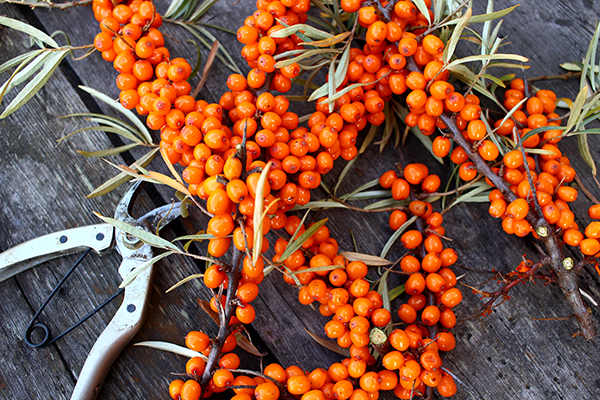
Speaking propagation produces buckthorn once it is established, often suckers that is easy to dig up and move on. Furthermore, buckthorn be easy to propagate from cuttings. According to a excellent report of sea buckthorn cultivation written by Kirsten Jensen on the Administrative Board of Västra Götaland needs cuttings, however, stand in the clean sand to root, which may explain why I never have succeeded with cuttings of sea buckthorn I stopped in a mixture of soil and sand. You can also fröföröka buckthorn and it can be a fun way to get new plants with new properties. The disadvantage is that you then do not know if there will be a he- eller honbuske som man får. From sowing to first bloom, it can take three to five years.
The fruit is sometimes compared with oranges, but if you look closer at the nutritional content appears orange right nutrient poor relative to sea buckthorn. Seabuckthorn contains e.g. 33 times more Vitamin A, 23 times more beta-carotene, 6 times more Vitamin E and 2,5 times more Vitamin C than orange. In addition, sea buckthorn is one of the few fruits we can grow that contain valuable fats, whole 50 times more fat than orange.
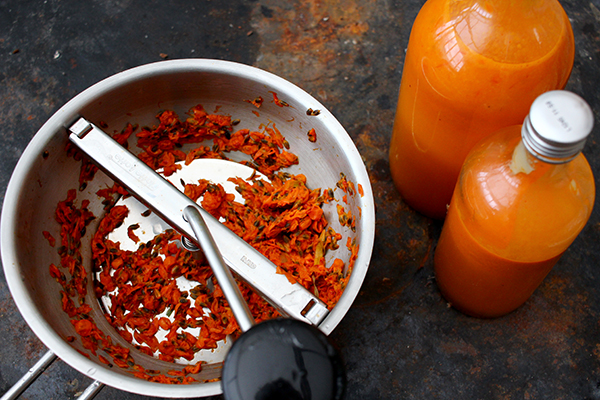
A good way to conserve sea buckthorn (besides freezing) that preserves its nutritional wealth in a good way is to manufacture so-called oxymel of berries. I found the information on this preservation method in Ben Falk's book "The resilient farm and homestead" (2013) and have tested it a few times since then. All you have to do is mash the berries down and press them through a sieve so that the juice runs out. For every liter of juice add the approximately 3 cup honey 1,5 dl cider vinegar. Pour the mixture in the bottle and shake well. Store in the refrigerator and stick easily a year. I drink a couple of spoonfuls a day to prevent colds autumn- and winter.
This year was the first really good with the fruit of our oldest buckthorn shrubs, full five liter three bushes. The desire to cultivate citrus fruit has suddenly become much less.
Kan havtorn ikke være ganske invasiv der hvor den trives? Hvor enkelt er det at kontrollere den?
Hi. Jag guidar två agronomer från Sydamerika , Uruguay nu i Stockholm och de är väldigt intresserade av att se exempel sv skogsträdgårdar i Sverige.
Är de någon som kan tippas mig?
I Stockholm, Malmö och Göteborg .
Eller närliggande som är värt besök.
De arbetar med det i syd och är nu i Sverige i en Gmo kampanj där de har sett att använda sig av skogs system kan vara en lösning till att hitta ett annat agrosysstem en den nuvarande intensiva soja odlingen som inte är hållbart.
Är ni intresserade så titta in i hemsidan. http://WWW.framtidsjorden.se and see where and when to lecture in these cities.
Mvh Aurelio
Welcoming tipps
Is it possible to hedge them? So one of those English thorn hedge that can not go through? Compare with hawthorn.
Good question! In nature, rather they form the impervious thicket, so it should be no problem really, tags they have also so that there is sufficient. The question is whether one can half saw them as they do in England, I have unfortunately no answer to.
The link to Kirsten Jensen's report on sea buckthorn does not work but it was there when I searched for the name.
Tack, fixed!
Found interesting reading about this super berry sea buckthorn –
Potentially protective against Covid. Time to make oxymel.
https://www.google.se/amp/s/www.news-medical.net/amp/news/20210419/Plant-derived-compound-isorhamnetin-may-have-antiviral-potential-against-SARS-CoV-2.aspx