


As I wrote in first post on nötjakten in Medelpad we had the really came into the Västernorrland to check the status of the various Loiko-walnut trees, which is considered the hardiest trees of real walnut (Juglans regia) in the world.

In the end, we looked only at Ove Johansson's two trees, but we learned a lot more about the background to how these trees ended up in Sweden, something I've long been curious. Ove shared generously of all documentation regarding the purchase of the trees and the correspondence between him and the Belarusian breeder Romuald Loiko. Ove had found out that there was a breeding program for walnuts through a travel journal published by the American vinentusiasterna Tom Plocher and Bob Parke. They had visited the Baltic countries 1998 and including reported Dr.. Loiko grow over 300 different kinds of wine in their experimental crops at the Belarusian Institute for fruit growing. In passing they mention that the same Dr. Loiko also doing processing of walnuts.

Ove got in touch with Loiko in the early 2000s and began to order 100 seedlings of real walnut. Then he wanted to order the vine, but the deal fell through, then Loiko died spring 2004, 67 years old. Subsequent attempts to connect with the Belarusian Institute where Loiko worked remained without success.

Of the e-mails that Loiko wrote to Ove seen that the trees were processed for both resistance and early fruit set. The plants came to Sweden in the early spring 2003 and was then barely a year old. From their appearance made it a gradation of plants, which is of course extremely difficult to decide in such young trees, where No. 1 had the most promising capabilities and No. 100 was the least interesting tree. Loiko No. 1 and the tree whose numbers Ove not remember ended in his garden. The rest was distributed among friends and acquaintances, and many donated to municipalities, park administrations and even Uppsala Botanical Garden received three copies (No. 2, No. 63 and No. 80). Most surviving trees are around Ornskoldsvik, Sundsvall and Kramfors, one on Gotland, another at Ove's son Louis in Singapore and two (No. 63 and No. 80) remains in Uppsala Botanical Garden.
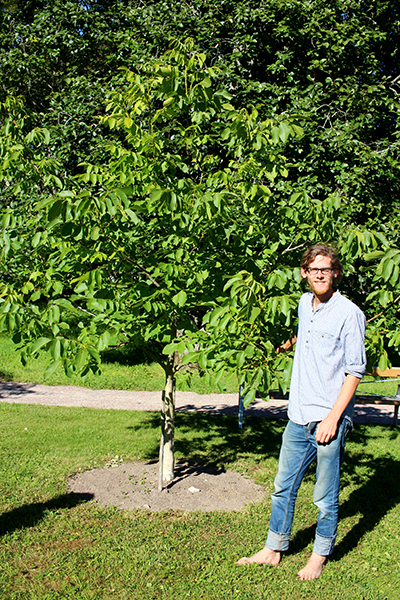
Several trees have already begun to produce fruit, the northernmost of them are in Örnsköldsvik (No. 54). Loiko No. 1 is the most productive time position in the tree, but also No. 63 have produced some nuts. Both of these trees are propagated by Lars Westergaard using grafting and has been on the market a few years now. A clone of No. 63 we planted in the garden Diversity in Stjärnsund this summer and it will be exciting to follow its development. We have asked Ove sending scions from as many trees as possible to Lars Westergaard, so that he can continue processing the work on a broad basis.

And of Belarusian Institute for fruit growing? There are actually there and I have started to pull the little threads to make contact with them in the hope to import some of the many exciting plants they have developed where. More about this will hopefully in the winter!
Hi! Very intressant..När Lars grafts example, a hardy Loiko on another rootstock, which it is? Is it Normal Juglans regia, that is not as hardy…? They want well also the root system is hardy? For me it will be otherwise hardy scions of less hardy root system? Or do you know how they work?
Hi! I think Lars grafts of genuine walnut, so it's definitely a weakness. But I think he is about to pull up their stocks of resistant graft, so over time it should be solved. I will return with a report from the plant in Stjärnsund spring!
Hi!
Yes, I hope they go well with it and that maybe someone of your loiko nuts germinate.
Another question: you know what it is that makes grafted Walnuts can get nuts after 2-3 year and not seeded after about 10.. Why do they produce nuts before just because they are grafted?
Sincerely Bjorn
Hi Björn,
I'm not entirely sure why this is so, but I would imagine that there are several factors that interact. Firstly, the rootstock usually two to three years old from the beginning. Ympriset can then start to focus on fruit set earlier than one as old seedling, because there is a more established root systems that supply the processed part of nutrients. Then many of the names resorts designed for early fruiting, so it'll also record and perhaps to make some age on it. There are certainly other factors affecting – someone who knows?
/Philipp
In California, the grafts sometimes walnut onto rootstocks of wingnut, pterocarya, To assure the walnut orchards on waterlogged land. Several of the wing nut species, are a very hardy so it is perhaps idea to try in Sweden because of the.
Thanks for the comment, how exiting, it should be tried!
Should he possibly could graft on julglans Manchu rica ?
Worth to try anyway.
Have two Loiko I inoculated on just Mandshuri rootstock. This year was the second spring and there were seven female flowers. Now male buds were also planted for flowering next spring.
I think it's like with, for example, apple: you always get the graft from adult trees, fruit-bearing stage, and then the new tree also skips the youth phase and goes directly to the generative phase. This can also be a problem as you have to prune the young trees carefully so they don't set fruit too early and thus break.
Does anyone know where to buy a loiko-plant or seed nuts of loiko? I have heard me at local nurseries (Northern Vastergotland / Örebro) without success, and is so eager to find a plant!
The only place I know of that sells grafted Loiko trees are Westergaard nursery in Denmark, http://westergaards.dk/. The crux of his plants is that they are grafted on the common walnut with less resistance and most of the plants I've seen around Sweden have actually died after one or two seasons.
Hey, we have some Laiko kernels as you can get, and then plant them in about. 20 cm. depth.
If you plant them now in the winter, you have 30 cm. large plants in August 2018.
Can you plant them 30 cm. from a stone wall with south facing and preferably with a basement in the house so you are guaranteed fine genesis. Then you can move the plant after 1-3 year, but keep in mind that the time has taproot.
Hi,
I am very interested in planting 2 Lailo trees on an island outside Grebbestad, sandy soil..
And 2 Northern Västmanland in loam with plenty of water aquifers.
Suggestions on how I can get seeds or plants and how to plant them?
Who can I contact for more help and insights on this?
Hi
Would I be able to buy some seeds of Loiko of you
Hi, interesting reading about this resistant variant of genuine walnut. Would love to try to plant a tree outside Stockholm. Is there more cores available?
Hello Arne,
I would be very grateful if I could buy some Laiko kernels of you and try to get to germinate.
I have an undefined walnut that I planted the seed / nut and which is now nearly 13-14 years, but not given nuts than. With the hardy walnut, I hope it will change the.
Also believe that Sesame association would be interested.
/Per
Hello Arne, I would love to buy some Loiko trees from you if you have them there.
Regards Niklas
Hi! If you have the nuts Laiko walnut I am interested in buying some . Sincerely Per Nilsson
Moil 0730397998 or 0725764473
E-post pernilsson15@yahoo.se
I can be reached on phone no 0762787979
Or nannyhillerbrang@gmail.com
Hello Arne,
Do you possibly have any Laiko walnuts that you can sell me?
Hello Arne,
Can I also buy? 1-2 Time fröar?
amir@seifalian.com
Hello Arne,
Are you still sending nuts to stakeholders?
With kind regards
Wulf
Hello Anneli.
We have a large Loika in southern Sweden so you can get nuts / Seeds of me.
Hello Arne,
Would be very grateful if you can spare a few loikonötter to me too. Paying course postage and expenses. I can be reached at per@vonbahr.eu or 0705515151
I am very interested in buying loiko seed also!
Regards Niklas 0720368682
Hello Arne,
Also I would be grateful if you can spare a few loikonötter. I pay the postage and expenses. You reach me at klasoskarsson@hotmail.com or 070-3413877.
Regards
Classes
Hello Arne,
Although I am very, very interested to buy Loiko seed you!
Get in touch: saga.maria@gmail.com
text to: 070-2003933. We are happy to pay, we Swish o sends the address of SMS. Sincere thanks!! Peace, Maria
I know it might not work, but do you have any Loiko nuts to sell ? sjusovarna@gmail.com
Thanks Miroslava
Hi,was in Scania offers,would love to buy some nuts to your loikoträd if it goes well,myself, I live between Ystad and Skurup.MVH Tommy
Hello Arne, it is still possible to buy seeds from you? Would who try to grow Loika in Rättvik, Dalarna.
With kind regards,
Jessica Olsson
jessicaolsson69@outlook.com
Hello Arne!
I wonder if you might have any lolike seeds left? Regards Joline
joline7@hotmail.com
Hello Arne!
This thread is a couple of years old, but I still write.
Want to try powering up Loiko, so did my friend Ida. Do you have any nuts you can think of to send us for postage and an additional sum that I can Swisha?
0762614600
Can Loiko as trees or nut to get hold of in any way? Why I ask this is because it seems to be the best chance to get an answer. Regards
Lars Westergaard may be grafted Loiko trees in its nursery outside Odense, believe he has stopped sending the mail: http://westergaards.dk. Otherwise it is very difficult to get hold of these, but we're working on it (more about that, I can reveal about half a year or so).
Please
Philipp
Hi.
Has set three walnut kernels from Ukraine (två overgrown) they were three years.
Is it possible to get or to buy a handful of walnuts from someone
have nuts of Loiko. Lives about four mil south Lidköping in Singapore.
Hi! Is someone who is nuts of Loika walnut or plant . I am interested in the lives of Värmland.
Mvh Per
Hi!
I am considering some of the qualities you would expect of a seedling of nuts from a 'Loiko' tree. I'm not completely loaded on genetics and breeding, but I understand that it may depend on how it is processed by Mr. Loiko in Belarus? Does anyone know how this name variety is produced or what you can expect from the seeds?
If the tree stands alone but still get nuts, it is because it is self-pollinating? Will seedlings from nuts more like the mother plant when, than if it is pollinated by another tree?
//Joakim Norrkoping, which has five cores picked during Loiko No. 63 on stratifiering in winter.
Hello Joakim,
I was recently in Belarus and talked to people at the research institute where Loiko worked. If I made the right selected him in the first place for hardiness, early fruit setting and something called lateral fruksättning. This means that pages branches can produce flowers, resulting in a greater harvest at an early age and more fruit per square meter of cultivated area than if the trees are top bearing, Thus bloom mainly on branch tips. In nature, top walnut trees bearing the absolutely most common. Another feature he selected for the apomixis, which means that the tree can put fruit on the female flowers without coming into contact with pollen from the male flowers.
If you got your fruits from Loiko 63 Uppsala is a great probability that pollinated the trees nearby, pollinering can happen in 1000 m or more if the wind is right. That in turn probably means that you can not predict some characteristics of seedlings, but chances are good that you get a decent hardy tree. I have incidentally never succeeded in getting nuts from Loiko 1, 63 or 80 sprout, so please tell me how it goes for you.
Hope you got your answer!
/Philipp
Okay, exciting! Is there a difference between the expected properties from a seedling of nuts pollinated by a different tree than the parent tree than if it occurred with apomixis? In the latter case, the genetic material to be a lot like the parent tree, except for mutations, one believes? Should it then be better to take a nut from a tree that grows quite isolated if you want as much as possible of the parent tree characteristics?
I'll tell you if I manage to get any plant! Unless you managed it sounds like the chances may be quite small.. I have some in the fridge and some on the balcony, in moist sand. Will probably be planting in February in pots indoors.
And thank you for a very interesting blog and Instagram!
And, it matters if a tree stands alone or not. Loikos Former graduate student we met in Belarus bought a country house far out in the boonies right to control the pollination of their trees. Then I do not know how close to the mother plant offspring will be, sometimes read that apomixis involves the mother plant clone himself using a seed, sometimes it says that they still differ. Would be glad if someone could find out what applies to walnut. Found by the way the information in an old paper Loiko wrote 1990 (“Apomixis of Walnut”) to germination of nuts produced using apomixis is far below that of pollinated trees (16,7-50%), which may explain why I have not managed to fröföröka with nuts from some of the isolated Loiko-trees.
A small addition: If I interpreted this rather complicated article right there is a big chance that the seeds produced by apomixis are clones of the parent plant: http://www.globalsciencebooks.info/Online/GSBOnline/images/0706/FVCSB_1(1)/FVCSB_1(1)53-59o.pdf. When required, however, to know that they are apomictic. Walnut can in fact also be self-pollinating if he- and female flowers bloom at the same time a period. The surest way (in addition to wood plastic bags over the female flowers) is waiting on a cold spring when all the male flowers freeze away and picking the nuts as yet produced.
Who can offer Loikos 1 scion wood?
Hi! Have read about Loiko trees and think it sounds too good to be true. Remember a garden with walnut trees that I experienced as a child and would like to recreate a bit of that feeling. Would therefore very much like to buy some seeds
Best regards, Ossian
ossian.wennstrom@outlook.com
Hi.
Fun to read about Loiko. Have tried it myself a couple of times. Partly seedlings from Övik part a grafted on Manchurian from Westergaard. No one managed most due to bad luck.
This was a few years ago. Then I lay low for a while with Loiko.
Has a couple of other Juglans directed from the east. One is called big nuts and the other I do not remember. Has done quite well and one is blooming hard but has not got any nuts yet.
Although it would be fun to try Loiko again of course. Odlar i zone IV.
For info, just visited Lars Westergaard in Denmark and bought a Loiko approx 2,5 meters high for approx 20 liter jar. It already has some nuts on it. Lars said that he can send plants to Sweden. In the long run, he wants to switch more to bare-rooted plants to make it easier to send. According to Lars, walnut is unpretentious in terms of type of soil and pH but should be watered for two years after planting and kept free from competing soil vegetation in a 1 meters radie. He does not accept card payments.
Hello Carl,
I would like to know how the Loiko tree you bought is doing and what Zone or area of Sweden you stay. I am interested in planting one, but I do not want to waste my time if they do not produce nuts.
Thanks,
Lisa
Bought a Loiko last year at Skinnaren in Ljungby., They had 7 st. No idea where they came from, rooted or grafted .: The winter has been tough with frost and I did not have much hope as the days went by, the vegetation is in progress the oaks are green but not the walnut tree … But look checked again today and see: some buds are bursting. But should never shout hello too soon, but I do it anyway
ARDA
Bernard
Hello Bernard,
I wondered how your walnuts trees have done?
The prevalence 6 gave some nuts 2022 as I said. Hope they grow. Will report back on how it goes. The tree has good hardiness, has survived -30c twice without frostbite.
Hi!
The last comment here in the blog was written in February 2023. Does anyone have any news about Loiko regarding where to get trees or nuts to try the germination luck?
I agree. Hope the blog returns to Loiko and how it went!
I bought three trees from Westergaard's nursery, planted two at my place but none of them survived the winter (ca zon 3). My dad got one, who live near the sea (significantly warmer zone). It is still alive but growing slowly. My theory is that if they are grafted onto regular walnut as a rootstock they are not as hardy as if they were seeded, but this is a guess and hard to know.
I have a manchurian walnut, as well as two of the Canadian variety Broadview, that have survived the winter. None of my trees have gotten any nuts yet, will probably take another year or three.
It would be interesting to know if more people have succeeded in grafting onto rootstock from Manchurian walnut to get more winter-hardy trees. That could be a solution? I will also try with heart nut, they must be very durable.
Hello Moon ! For several years I have been grafting different varieties of 'true' walnut J regia on root stock of Mandshurian walnut and on hybrids of gray walnut. It was these species that survived the first winter without problems, while J regia quite often did not survive the first winter outdoors.
Regia grafted on Mandshurian root should have increased hardiness according to information from Eastern Europe. Vyrmantas R in Lithuania believes that one wins at least one cultivation zone.. In addition, growing in a raised bed provides better conditions.
However, the graft site is sensitive to frost in the first few years and needs frost protection. After two winters in the basement, all my grafts have successfully planted. A comparison is needed here with how the same variety of regia grafted on regia fares compared to those on Mandshurian root... It may also differ which regia you use as rootstock. The best hardiness may be to graft onto seed stock from a cold-grown Loiko.
In mild DK and Germany, only strong-growing rootstocks of regia are probably mostly used, which more quickly produces salable trees.
With hardier, more slow growing, more precocious rootstocks, you can probably get hardier trees with earlier and more abundant fruiting.