


The oaks is not among the first trees we think of when it comes to edible nuts. Still, they have been used as food in many parts of the world for hundreds or even thousands of years. In Korea, they are still an important source of carbohydrate.

As I write this post I chew on some sweet acorns from a subspecies of stone oak (Quercus ilex subsp. rotundifolia) which for centuries has benefited the people in the southern Spanish Genal Valley where I'm in a small isolated mountain village is surrounded by forests of chestnuts and sötekar. No one that I asked here will remember the sweet acorn has been used for anything other than snacks, but they are still an important part of the Iberian pig breed and would definitely be a good carbohydrate sources for people too.
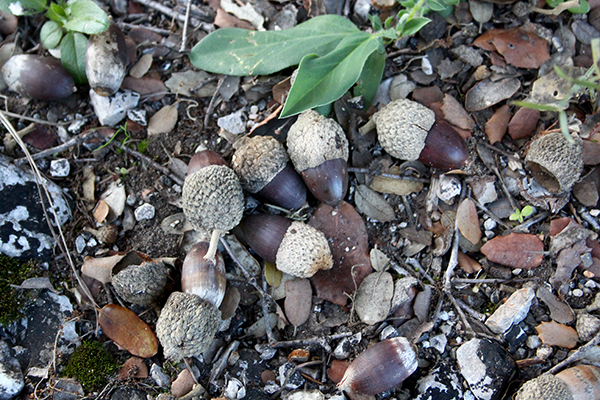
Unlike Spanish the honeymoon core contains most of the oak fruits more or less amounts of tannins that give a bitter taste. The most common oak in Sweden's forest oak (OAK), whose fruits have high tannin content that must be leached out before the fruit can be used as human food. Traditionally, the husband cloth sacks filled with peeled and crushed acorns in streams that for some hours leach them. A modern and very smart variant of this for indoor use is to add peeled and crushed acorns in a small cloth bag that you put in a toilet cistern (even smarter, it is understood to have a compost toilet and use the traditional method). When water is no longer discolored when you flush you know that the tannins have been macerated [1]. The problem of the leaching process is also minerals leached, which significantly reduces the measured value ollonens. Therefore, it may be appropriate to cultivate species of oak that has naturally low tannin content. Suitable species for Swedish climate could be
- Svelte (Quercus alba)
- I Bebbs (Quercus x bebbiana)
- Kärrvitek (Quercus bicolor)
- Kardborrek (Quercus macrocarpa)
although there is very little information on how they fare in our latitudes. We will plant Quercus bicolor and Quercus macrocarpa in Putt Myra forest garden in the spring and hope to get a hold of Quercus alba eventually, although the chances are slim that they will thrive in our climate.
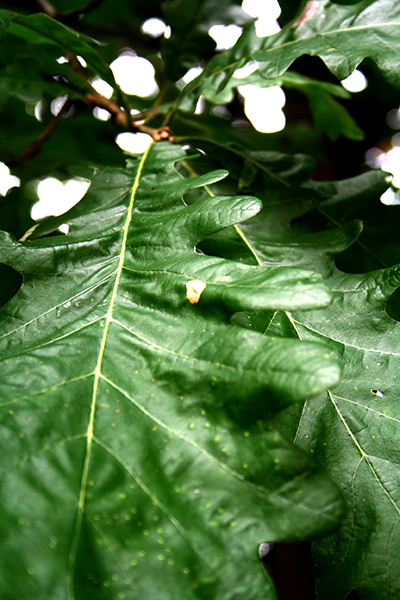
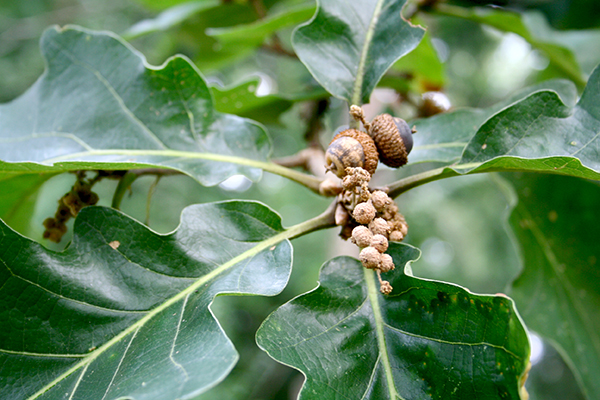
Full-grown oak trees can provide 7,5 tons of acorns per hectare, but most species have a tendency to give an irregular crop, with two to five years between harvests [2]. Many species also gives its first harvest after 25 to 30 years. Individual trees can provide between 90 and 300 kg acorns per harvest, depending on the species. Should the oak become a part of our staple diet, it will, therefore, require fairly long-term planning and patience, something we might not have shown us to be so good at the last decades.
Another nut who takes a little time to give fruit is the nut allen we will look at in the next post.
Literature
[1] Gustafsson, M., 2013 [personal communication].
[2] Crawford, M., The oaks. Agroforestry News, 20(1): p. 1-40, 2011.
Incredibly interesting! Önskar jag hade en tomt att plantera en ek på NU 🙂
Top! Good research you are doing. I'll certainly find o plant some trees. Have seen your tips on nurseries.
Do you know :
https://en.wikipedia.org/wiki/Quercus_muehlenbergii
Tror jag såg ett sådant exemplar i Bergianska sthlm om jag inte blandar ihop saker och ting. Apparently edible glans without leaching.
Hi
Jag hade också gärna planterat en eller fler ekar om bara min enda ek på plasen, my uncle had given some acorns. Now I have lived here since the winter 017 and never seen any glans.
What kind of variant is it?, answer me if you can.
På mitt förra ställe fanns det mängder och skott i marken, but there is a long way to go now.
Hi,
how old is your oak tree? De i Sverige inhemska arterna ger inte skörd förrän 40-50 years usually. Dessutom behöver de flesta ekarna pollineras av ett annat träd (through wind), so it may also be that there are no pollen donors in the landscape where you live.
Hi
Thanks for the reply. Fun!
What you mention at the end, that there may be no pollen donors in the landscape, can probably be true. I've been looking around lately and do not see a single oak. Mine is probably planted. The house was built in the 60's and according to an old photo there was no oak then , but difficult to know how old it is .
I went to a place in Dalsland where oak grows and picked some ollon to plant. Hope they want to get along. They were brown but probably of the later harvest, and lay under leaves. It has been quite cold here in southern Värmland for a while, hope they do not freeze. I like oak and ash. Stately friends.