


In the second part of the series on the nuts we'll look at hazelnuts, which seems to be the most famous nuts in Sweden.

Hazel occurs naturally all the way up to Umeå, where there are surviving populations from a previous warm period that lasted for about Sweden. 11 500 years ago when hazel formed forest with linden and oak. Viable populations of hazel is also found around Torsåker in Gastrikland and Southern Dalarna.

These wild hazel bushes (Corylus avellana) provide relatively small nuts and have the tendency to a harvest every two years, then they need to gather force during two summers to produce fruit. Even in processed, great fruity varieties, it has been difficult to breed out this property. Most names varieties of hazel starting to bear fruit after three to four years, and the fruits sitting on last years wood [1]. Most names varieties grown today are of the species C.. Hazelnut eller C. top (which differs very little from C. hazelnut) and many popular varieties, so that for example 'Jättenöt from Halle' are hybrids between these two. The hazel can grow well in shade and thrives on sloping habitats, happy to answer fairly easy, sandy soils mixed with copious amounts of moving water in the soil [1]. It is also in such places as we can find the natural population in Central Sweden. In order to provide fruit needs hazel bush much sun and regular pruning is recommended.
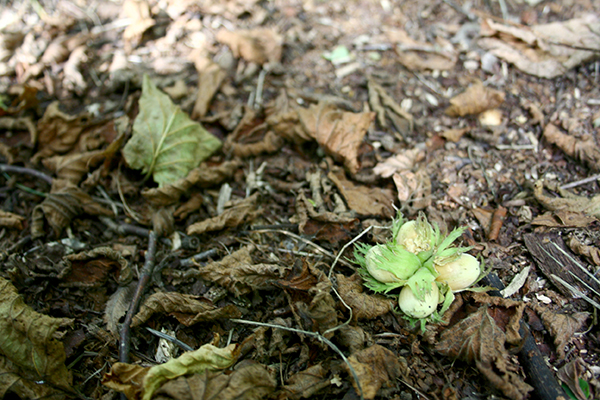
All hazel bushes are wind pollinated, and she has- and male flowers on the same bush. Still, they are usually self-sterile, when she- and male flowers ripen at different times. Pollen is spread early in the year, in February and March, but the very conception occurs only in June. All of the pollen does not survive the long wait between pollen dispersal and fertilization so about 20 % the nuts remain opollinerade [1], even the most refined varieties. As a rule, we need one or more pollination varieties to get a good hazelnut harvest, because he- and female flowers rarely bloom at the same time on the same plant. Wild Hazel is usually recommended as pollinators, likewise cultivar 'Cosford' and the variety 'Lodgepole' (ormhassel), that blooms relatively late and thus can reduce the risk of late extreme cold makes the conception fail, which means that empty nuts produced [2].

The Turkish hazel trees (C. colurna) is a species in the genus Corylus, as opposed to the bush-like C. avellana and C. maxima are enstammad. The tree can be 25 m high and produce large quantities of nuts that are stuck together in clumps of about a dozen nuts. The tree is at least hardy to production zone 4 in Sweden. There are also hybrids between C. colurna and C. hazelnut, C. colurnoides which has proven to be very promising in Danish experimental cultivation, with respect to both crop variety and hardiness [3]. In the spring we get three different hybridhasslar from Westergaard's nursery to Putt Myra forest garden to evaluate how they work in our growing climate.
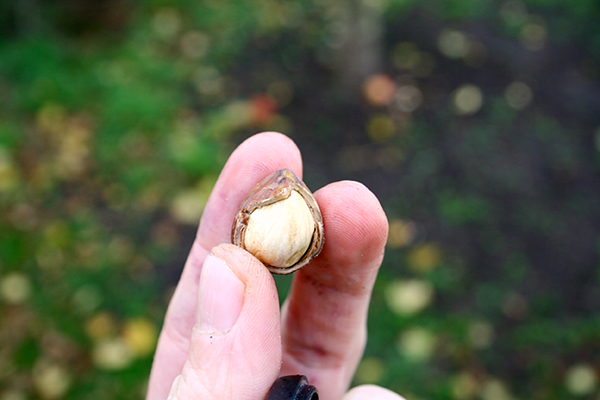
In Putt Myra forest garden we grow right now Twelve different varieties of great fruity hazel, but it is still too early to assess which ones are the best. So far it seems that the habitat is of greater importance than the variety of how much growth there will be. We harvested a handful of nuts cultivar 'Cosford’ and some nuts of an ornament hazel called 'Aureum’ 2013 and 2012, but got no harvest at all this year. In the literature, recommended varieties 'Lambert Filbert', ’Cosford’, 'Long Early Zeller', ’Waterloo’, 'Nottingham Prolific' and 'Jättenöt from Halle' for our climate [2]. A rule of thumb is that the nuts are doing better, the later they begin their development. Hazelnuts said to provide harvests 0,8 t / ha [2] to 2 t / ha [1], where each tree yields 2 to 4 kg nuts on average. The hazelnuts are among the fat-rich nuts and more on their nutrient content and how it stands out in comparison to other nuts come in a later section of this series.
Next post will be about walnuts, which has much more potential in our climate than many believe.
References
[1] Crawford, M., Nut Crops – Appendices, 2012.
[2] Nylinder, B., Nötodling southern Sweden – with focus on hazel, 2013.
[3] Westergaard, L., 2013 [personal communication].
Good info, interesting! Looking forward to next section!
Am interested in nut trees that grow well in Gotland
thanks
Any of the nut trees featured in the series on nut growing for Swedish conditions should work in Gotland, potentially with the exception of some of the nut pines that may not do well in too alkaline conditions. You could also try inoculate hazels with truffels, something that’s very difficult in most other parts of Sweden.
Hi, Thanks for the info. I would really like to get some nursery hazel nut trees to plant rite now. I can’t seem to find any of the improved varieties such as cosford cob, which is very big in England. All the nurseries here seem to only have ornamentals. Anybody that can give me contact info of a nursery on the mainland that ships nut trees to Gotland, it would be most appreciated.
Thanks,
Ron Cox
Here you find a ton of links to nurseries: http://skogsträdgården.stjärnsund.nu/plantskolor-for-skogstradgardsvaxter/
Hej Philipp, I wonder if you have an eye on where it's going to get hold of the scions of nut trees, eg hazel I and his partner intend to buy, but because. lack of space meant ockulera in more varieties of. Is it possible to buy through you have several varieties or elsewhere?
Hi Kenny, I am not aware of anyone selling scions of nut trees, but you could check on fruitiers.net which is a replacement page for scions. I have not had time to get involved with selling scions, but that may change next season. Hello / Philipp
Hi!
Do you have any tips on where I can find hazel trees in Umeå?
Hej Philipp, just reading your handbook on nut growing and getting a little confused about the hazelnut varieties Barcelona and Barcelonskij which you describe as two different varieties. When I check a number of different nurseries in other countries, I get the impression that it is the same variety with Catalan origins but that it spread early to both the USA and Eastern Europe and became popular on both sides. Is it really a matter of two different varieties?? Sincerely, Magnus
Hi Magnus! It could absolutely be that 'Barcelona’ and 'Barcelonsky’ is the same variety, but when I wrote the book and read descriptions of 'Barcelona’ I didn't think the nut looks like 'Barcelonskij’ as I have seen in the Baltics. It also seems to be mostly grown in warm climates, ie Spain, USA and southern France. ‘Barcelona’ is also rounder, medan de 'Barcelonsky’ I have seen have been more angular and have the same appearance as 'Eckige Barcellones'. According to the study “Incompatibility Alleles of Hazelnut Cultivars” by Mehlenbacher (2014) is 'Barcellones Zellernuss’ and 'Barcelona’ completely different varieties. ‘Barcelloner Zellernuss’ is, as far as I know, the same variety as 'Eckige Barcelloner'. Incredibly confusing of course, but it was these data and my own observations that led me to the conclusion that 'Barcelonskij’ more likely to be synonymous with 'Eckige Barcellones’ than with 'Barcelona'. But like I said, I could be completely wrong, or several different varieties may have been named 'Barcelonskij', much like 'Rote Zellernuss’ can be a little anything that has red leaves.
Greetings, Philipp
And, it may not be easy to sort out and it may require genetic studies to ensure definitively. Barcelona(j) seems to mean anyway “from Barcelona” in the Slavic languages and of course it can relate to several different varieties. Barcelonski seems to be common in, for example, Poland, Ukraine and Russia where a number of nurseries describe it in a similar way and that it is also grown commercially on a large scale, no mention there of possible mix-ups as far as I can see. Anyway, I bought Barcelonski of Polish origin so it should work well here. I start with three named varieties but also intend to supplement with a wild hazel as you suggest. Do I gain much by using a local provenance do you think or will pollination be good enough even with a milder origin as long as it is the true species?