


Yesterday I attended a mushroom growing course here in Stjärnsund. The reason I wanted to learn more about how to cultivate edible mushrooms is that they are a very good complement to the other crops in the forest garden. All products that I receive from so far Putt Myra Forest Garden is produced by plants. In the forest garden contains a number of consumers, both primary consumers that eat the plants (and I'm one of them) and secondary consumers that eat primary consumers. Then there's also the third of the consumers that eat secondary consumers, etc.. What unites all these producers and consumers is that they will eventually be taken care of decomposers, which can be animals, bacteria or fungi. Research on a deciduous forest in the northeastern United States from the late 1970s showed that the decomposers in the form of fungi and bacteria takes care of approximately 70 times more of the energy circulating in a forest than primary consumers consume in the form of seeds, fruit and leaf mass [1]. By introducing edible mushrooms to the forest garden What I am trying to hook me up on this great energy flow and get more of the solar energy that radiates into the place.

Mushrooms course was led by horton omen Christina Persson on Ecofungi i Malmö. We went through different growing techniques and I plan to avail myself of two of these techniques: mushroom cultivation in logs and in garden beds of wood chips. The latter, I will report on in a later post when I laid out bed. Mushroom cultivation in logs starts with getting hold of the raw material. Logs with a diameter of 10 to 15 cm is the best and they should preferably not exceed 1 m to still be manageable. The logs must be relatively fresh, but shall be stored in two weeks to the fungus resistant enzymes in the wood is to be broken down. Then the log ready to be colonized by fungi degradation and that is when they are prepared for mushroom cultivation. Most nedbrytarsvamparna best grown in hardwood and the heavier and the higher density wood has, the longer we can produce mushrooms from logs. This is why the oak very well as raw material and such logs may produce mushrooms for up to six years. Since Dalarna not direct flooding exercise of oak logs, we had instead logs of elm, hägg, to the, Maple, birch and willow which we will evaluate in the near future. These stops producing mushrooms for about four years, with the exception of elm that could possibly produce as long as oak.
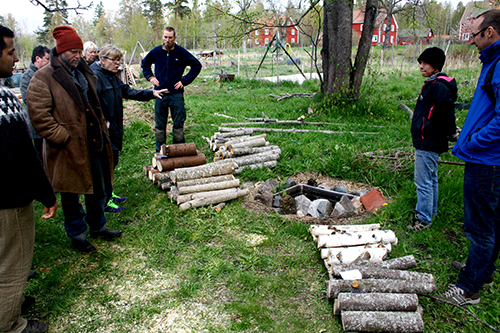
The actual preparation is done by drilling holes with a diameter of 8 -9 mm around the entire log. The holes should be 10-15 cm apart and arranged overlap as shown in the picture below. Then fill the holes with a wooden plug that is infected with a fungus, we want to grow. The holes should be at least 5 mm deeper than träpluggarna, so that the fungal mycelium has room to grow into the wood. The plugs are struck down with a wooden- or rubber hammer into the logs and they should sit flush with the bark. It's not easy to make your own wooden plugs, so we will test various techniques for growing mycelium themselves ahead.


Finally waxed holes with melted and very hot beeswax. This is done to reduce evaporation from the logs. Also any damage to the bark and sawn off branches wax to reduce evaporation. The ends of the logs are usually Christina not wax, because it becomes more difficult to irrigate the logs if they are completely sealed with wax.
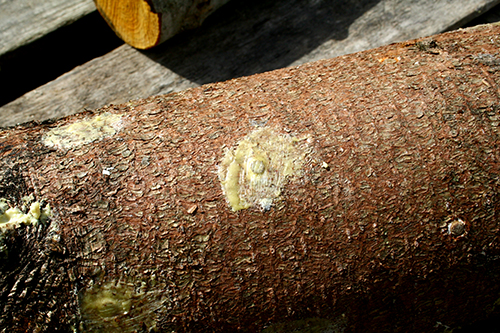
We inoculated logs with mycelium of ostronmussling (Bulbs), shiitake (Lentinula edodes), coral ticking (Grifola frondosa), kejsarmussling (Pleyrotyris eryngii) and varnish ticking (Ganoderma lucidum), which is a medicinalsvamp boiling tea on. In addition, we tested inoculating pale ostronmussling (Pleurotus pulmonaris) Whitewood, which we hope will work well, because there is so much fir available here. All fungi we grafted in the stock is very nutritious and has health benefits, such as anti-inflammatory action, anticancer or strengthening of the immune system. Ostronmussling contains e.g. 27,7% protein and lots of different vitamins.
Now that the logs are groomed put them in a shady and damp place in the garden, but not to the ground, but on for example a wooden pallet, so that competing fungi makes it more difficult to colonize logs. When the logs are completely genomväxta of fungal mycelium can be moved to an upright position against a wall or similar. It becomes dry and hot need logs watered, for example by placing them in a bucket filled with water one day, whereupon they turned the other way and let stand another day. Hopefully it will be a first mushroom harvest in a year or so!

If you want to study the subject recommended Christina two books by Paul Stammets, which is considered one of the foremost experts in the field: Mycelium running from 2005 [2] och Growing gourmet and medicinal mushrooms från 2000 [3].
Literature
[1] Gosz, J.R., H.R. T., L.G. E., and B.F. Herbert, The Flow of Energy in a Forest Ecosystem. Sci Am Scientific American, 238(3): p. 92-102, 1978.
[2] Stamets, P., Mycelium running : how mushrooms can help save the world. Berkeley, Calif.: Ten Speed Press, 2005.
[3] Stamets, P., Growing gourmet and medicinal mushrooms. Berkeley, Calif.: Ten Speed Press, 2000.
Interesting to read – how did it go?
Already, We harvested some oyster mushrooms last year, but fungal culture is nothing that goes by itself directly, logs need looking after for a lot to be able to put fruit in our right arid climate. Last year we grafted into a lot of shiitake which should put the fruit in the years. There is still much to explore in fungal crops grown in Sweden.
Hej Philipp
How has it gone now after a few years of your mushroom cultivation, What do you make?
Hello Joakim,
this year we got maybe a couple of kilos of shiitake mushrooms from two logs. Most harvest we received from an oak log, but also birch logs delivered. All other logs we did 2015 has stopped giving sponge or never made it. Shiitake-harvest we received right after the snow melts when it was still very humid, but already hot in the air. My conclusion is that you need to have a daily track of the logs during the season and the need to water or soaking them, because the natural conditions of us do not favor the production of oyster mushrooms and shiitake. Financially, it has so far been a loss of business with growing mushrooms on logs and we would need to spend much more time on it to get more return.
/Philipp
Thanks for posting this awesome piece.
Idk what your situation is but I’m living in Stockholm now and will be moving to Dalarna (Mora) in a few years and intend to grow.on logs and straw beds. Maybe eventually develop into a shipping container set up.
Are you living up in Dalarna or else where? I’m looking for good mushroom connections as it’s intimidating doing this along.
Thanks for the awesome read, will check out more of your work!
– Ainslie Blakely-May.